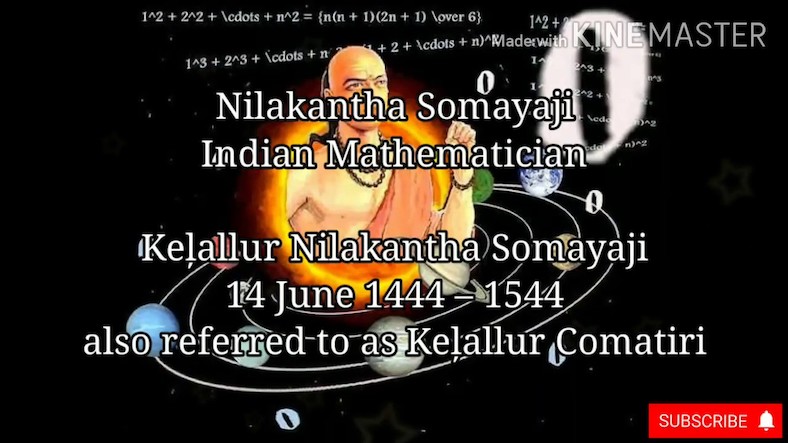
Nilakantha Somayaji, also known as Nilakantha or Neelakanta, is one of India’s greatest mathematicians and astronomers. He lived in the 15th century in Kerala and played a major role in shaping the future of Indian mathematics. His ideas were advanced, scientific and centuries ahead of their time.
Nilakantha belonged to the famous Kerala School of Astronomy and Mathematics, a group of scholars who made extraordinary discoveries in trigonometry, calculus-like methods and planetary models. Many of their ideas appeared in Europe only 200 to 300 years later.
This article explains his early life, work, contributions, mathematics, astronomy, examples of his discoveries and his lasting legacy. The aim is to give you a clear, simple and complete understanding of why Nilakantha Somayaji is considered one of the brightest minds in India’s history.
Early Life and Background
Nilakantha Somayaji was born in the 15th century in Kerala, most likely in the region around Thrissur or nearby areas. The exact year of his birth is not known, but historians place it around 1444–1445 CE. His family belonged to the scholarly Brahmin community, which was well known for producing priests, teachers and scientists.
From a young age, Nilakantha showed great interest in astronomy and mathematics. These subjects were deeply connected in ancient India, because calculations were required for rituals, festivals, calendars, seasons and navigation. Kerala, at that time, had a strong tradition of astronomy and Sanskrit learning, and young Nilakantha grew up in this rich environment.
His early teachers were scholars who were part of the Kerala School. He learned Sanskrit, mathematics, geometry, planetary motion, observation methods and classical Indian astronomy.
The Kerala School of Mathematics – A Genius Environment
The Kerala School of Astronomy and Mathematics was active between the 14th and 17th centuries. It included brilliant scholars like:
- Madhava of Sangamagrama
- Parameshvara
- Jyesthadeva
- Achyuta Pisharati
- Melpathur Narayana Bhattathiri
This school made major contributions to mathematics long before the Western world discovered similar ideas.
Some of the Kerala School’s achievements:
- Infinite series for trigonometric functions
- Very accurate value of π (pi)
- Concepts similar to calculus
- Algebraic methods
- Advanced planetary models
- Detailed astronomical observations
Madhava, the founder, introduced ideas similar to Taylor series, hundreds of years before Newton and Leibniz.
Nilakantha Somayaji continued this extraordinary tradition and expanded the knowledge even further.
Major Works of Nilakantha Somayaji
Nilakantha wrote several important books, but his most famous works are:
1. Aryabhatiya Bhashya
A detailed commentary on Aryabhata’s famous text Aryabhatiya.
Nilakantha explained the complex ideas in simple language and added his own corrections and improvements.
2. Tantrasangraha
His most important original work. It includes detailed mathematical rules, astronomical tables and improved models for planetary motion.
Many scholars consider Tantrasangraha one of the greatest scientific works produced in India.
3. Golasara
A work that deals with spherical astronomy — a branch of astronomy that studies celestial objects using a sphere-like model.
These books show that Nilakantha was not only interpreting older texts but also creating new scientific knowledge.
Aryabhatiya Bhashya – Improving a Classic
Aryabhata was one of India’s earliest and greatest mathematicians. His book Aryabhatiya contains ideas on algebra, trigonometry, geometry and planetary motion.
Nilakantha Somayaji studied the Aryabhatiya deeply and wrote a commentary called Aryabhatiya Bhashya. His commentary did three important things:
- Explained difficult concepts clearly
- Corrected certain planetary calculations
- Added new mathematical methods
Because of Nilakantha’s explanation, many students in the Kerala School were able to understand and expand Aryabhata’s work. Without his commentary, Aryabhatiya might not have gained the wide influence it did in South India.
Mathematical Contributions of Nilakantha Somayaji
Nilakantha made many important discoveries in mathematics. Some of the most important ones are explained below in simple English.
1. The Nilakantha Series
One of his most famous contributions is the Nilakantha series. It is a series expansion that allows the calculation of trigonometric functions with high accuracy.
Google Ad 1
This method is similar to what we now call power series expansion. Today, modern mathematicians study similar ideas through calculus and Taylor series.
Nilakantha’s formula came hundreds of years earlier.
For example, his series for π (pi) gives extremely accurate values. Historians believe that Kerala mathematicians calculated π to 9–12 decimal places using these methods — far ahead of the rest of the world.
2. Improvements in Trigonometry
Nilakantha improved the ways to calculate:
- sine values
- cosine values
- arc lengths
- angles
He used infinite series and geometric reasoning to get better accuracy.
These improved trigonometric values were needed for:
- predicting eclipses
- tracking planets
- preparing calendars
- navigation
- temple construction alignments
3. Infinite Series Concepts
Nilakantha continued the work of Madhava in infinite series.
Infinite series are long mathematical expressions that continue endlessly but allow extremely precise calculations.
These ideas appear in modern calculus, but Kerala scholars used them centuries earlier.
Astronomical Achievements
Nilakantha was an expert astronomer. His observations and models were far more accurate than older systems.
Here are his most important contributions in astronomy.
1. Nilakantha’s Planetary Model
He developed a new planetary model that improved earlier Indian and Greek models.
Key features of his model:
- It was a modified geocentric model (Earth at the center).
- It included corrections to explain the movement of planets more accurately.
- It separated the motion of inner planets (Mercury, Venus) and outer planets (Mars, Jupiter, Saturn).
- His explanation of planetary longitude was highly precise.
His model was so accurate that some modern historians compare its predictive power to early European models.
2. Observations and Measurements
Nilakantha explained:
- The exact movement of the Sun and Moon
- The motion of planets across the sky
- Eclipses
- Equinoxes and solstices
- Calculation of the sidereal year and solar year
His tables and rules were used by scholars for centuries to create calendars and predict astronomical events.
3. Tantrasangraha – His Masterpiece
This book contains:
- Mathematical rules
- Planetary positions
- Geometry of celestial spheres
- Calculation of sunrise and sunset
- Methods for eclipse prediction
- Details of the earth’s rotation
He used geometric diagrams and trigonometric reasoning to explain complex ideas clearly.
Tantrasangraha is still studied today by historians of science.
Why Nilakantha Somayaji Was Ahead of His Time
Many of Nilakantha’s ideas came 200–300 years before similar ideas appeared in Europe.
Google Ad 2
Examples:
- Use of infinite series before calculus
- Accurate trigonometric table construction
- Advanced planetary models
- Highly accurate astronomical calculations
- Mathematical reasoning similar to Taylor series
This is why many experts refer to the Kerala School as “the first calculus school in the world.”
Fun Facts and Lesser-Known Information
- Nilakantha lived in a time when Kerala was a hub of science and mathematics.
- He worked closely with Jyesthadeva, another Kerala scholar who wrote Yuktibhasa, a text explaining calculus-like methods.
- His value of π was accurate up to many decimal places.
- His planetary model may have influenced later Indian and Arabic astronomy.
- Some of his formulas match modern trigonometric formulas exactly.
These facts show how remarkable his thinking was.
Legacy and Influence
Nilakantha Somayaji inspired generations of mathematicians in Kerala.
Even after his time, many scholars used his methods and expanded them.
His works influenced:
- Indian astronomy
- Indian calendars
- Temple architecture
- Navigation
- Teaching of mathematics
- Modern studies of history of science
Today, researchers across the world recognize the Kerala School as one of the brightest scientific traditions in human history.
Nilakantha remains one of its shining stars.
Why Nilakantha Somayaji Matters Today
Nilakantha’s work reminds us of India’s rich scientific heritage. Long before modern technology, Indian scholars had deep understanding of:
- geometry
- trigonometry
- astronomy
- planetary motion
- infinite series
His calculations continue to impress modern scientists. His ideas show that science develops in many cultures, not just in one place.
For Indian students, his story is a symbol of brilliance, hard work and curiosity.
FAQs About Nilakantha Somayaji
1. Who was Nilakantha Somayaji?
He was a 15th-century mathematician and astronomer from Kerala, known for his work in infinite series, trigonometry and planetary models.
2. What is Nilakantha famous for?
He is famous for the Nilakantha series, his commentary on the Aryabhatiya and his advanced planetary model.
3. What is the Tantrasangraha?
It is his major work on astronomy and mathematics, containing detailed rules, formulas and observations.
4. What is the Nilakantha series?
It is a mathematical series used for accurate calculations of trigonometric functions and π (pi).
5. Was Nilakantha ahead of his time?
Yes, many of his ideas appeared centuries before similar ideas were discovered in Europe.
6. What is his contribution to astronomy?
He improved the geocentric model, explained planet movement accurately and wrote important rules for predicting eclipses and planetary positions.
Conclusion
Nilakantha Somayaji is one of the greatest mathematicians and astronomers India has ever produced. His knowledge, creativity and deep scientific thinking make him a true legend of Indian science. From infinite series to planetary models, his works show a level of brilliance that still amazes researchers today.
By understanding his contributions, we also understand the extraordinary achievements of the Kerala School of Mathematics — a school that produced ideas far ahead of their time.
If you want to read more inspiring stories about great people, do explore more articles on PeoplesBLOG.
Thank you for reading!


