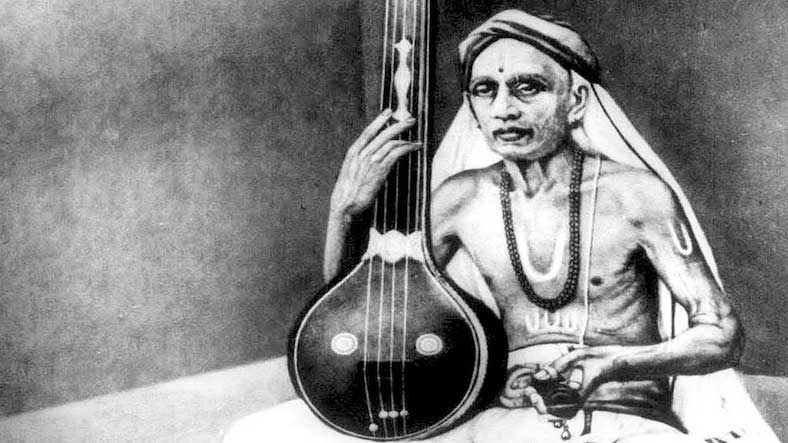
Tyagaraja (1767–1847) is one of the most celebrated composers in Indian classical music. His name stands tall among the greatest musicians of South India, and his works continue to shape the world of Carnatic music even today. He is remembered not only as a musical genius but also as a saint, a poet and a man devoted completely to spirituality.
Born in the temple town of Thiruvarur in present-day Tamil Nadu, Tyagaraja belonged to a musical family. His father was a respected scholar of Sanskrit and Telugu, and Tyagaraja began learning music at a very young age. Over time, he developed a unique musical style that was deeply rooted in devotion, classical grammar and emotional expression.
Tyagaraja is also part of the famous Carnatic Trinity, along with Muthuswami Dikshitar and Syama Sastri. Together, their works laid the foundation for modern Carnatic music. Among them, Tyagaraja is the most popular and widely sung composer, especially because of the simplicity, devotion and melodic beauty of his songs.
This article explores his life, music, philosophy, and how his compositions changed the history of Indian classical music.
Early Life and Background
Tyagaraja was born on May 4, 1767, in Thiruvarur. His family later moved to Tiruvaiyaru, a small town on the banks of the Kaveri River. It was in this peaceful environment that Tyagaraja spent most of his life, composing thousands of devotional songs.
From childhood, he showed a natural talent for music. He learned under the guidance of Sonti Venkataramana, a respected musician of that time. Tyagaraja was also deeply spiritual and spent most of his early years singing hymns, learning scriptures and composing short verses in praise of Lord Rama.
Even though he came from a family that had access to royal courts and wealthy patrons, Tyagaraja refused to take up a career in the king’s court. For him, music was not a profession but a path to divine awakening.
Devotion as the Core of His Music
The most unique aspect of Tyagaraja’s compositions is their deep devotion. Every song he wrote expresses his love for Lord Rama. Tyagaraja believed that music was a direct path to spiritual liberation.
His kritis often talk about:
- The importance of surrendering to God
- The value of humility
- The dangers of ego
- The beauty of righteous living
- The joy of singing the divine name
This combination of devotion and music is what makes his compositions timeless. Whether sung by beginners or maestros, Tyagaraja’s songs have the power to move listeners emotionally.
Many of his compositions reflect moments from his own spiritual journey. They show his struggles, doubts, joys and realizations. Because of this, listeners often feel a close personal connection with his music.
Contribution to Carnatic Music
Tyagaraja reshaped Carnatic music in several important ways.
1. Rich Melodic and Raga Exploration
Tyagaraja mastered hundreds of ragas, and he created compositions that explored each raga beautifully. His kritis bring out the full emotional range of every raga he used. Musicians consider his works as the best examples for understanding raga structure.
2. Introduction of New Ragas
He is credited with introducing or popularising several ragas that were not widely known before his time. Even today, some ragas are strongly associated with Tyagaraja because of his expressive handling of them.
3. Strong Foundation for Teaching
Music students across the world learn Tyagaraja’s compositions as part of their syllabus. His kritis help students understand:
- Melody
- Rhythm
- Gamakas (musical ornamentation)
- Voice modulation
- Raga elaboration
His works serve as a complete learning pathway for anyone studying Carnatic music.
4. The Pancharatna Kritis
Among his thousands of compositions, the Pancharatna Kritis (Five Gems) are considered his masterpieces. These kritis are sung every year at the Tyagaraja Aradhana festival in Tiruvaiyaru, where musicians from around the world gather to honour him.
The Pancharatna Kritis are:
- Jagadanandakaraka
- Duduku Gala
- Sadhinchene
- Kanakana Ruchira
- Endaro Mahanubhavulu
Each kriti is a brilliant example of lyrical beauty, rhythmic complexity and emotional depth.
Innovation and Simplicity in His Music
Tyagaraja’s music stands apart because he combined two rare qualities: the depth of classical knowledge and the simplicity of expression.
He used simple Telugu words that even common people could understand. At the same time, the ragas and rhythmic structures he employed were highly sophisticated. This perfect balance made his songs accessible to all sections of society.
1. His innovations included:
- Creative use of swara patterns
- Smooth transitions within ragas
- Use of conversational style in lyrics
- Emotional storytelling
- Fusion of classical structure with devotional poetry
Musicians often say that Tyagaraja’s songs have both soul and science.
Google Ad 1
Personal Life and Values
Tyagaraja lived a simple, disciplined and spiritual life. He refused gifts, titles and positions from kings because he believed that music should not be commercialised. He remained devoted to his family deity, Lord Rama, throughout his life.
He spent most of his days:
- Composing new songs
- Teaching students
- Singing in the temple
- Meditating
- Participating in spiritual gatherings
He believed that the purpose of music was self-realization. His compositions repeatedly remind listeners about the dangers of pride, dishonesty and material desires.
Because of his moral values and simple living, he is remembered not just as a musician but as a saint.
Tyagaraja Aradhana: A Global Festival
Every year, thousands of musicians gather in Tiruvaiyaru to celebrate Tyagaraja Aradhana, a festival held in his memory. The main event is the group singing of the Pancharatna Kritis.
This festival has now spread to:
- The United States
- Europe
- Australia
- Singapore
- Many Indian cities
The global reach of this festival shows how influential Tyagaraja's music has become.
Legacy and Influence
Tyagaraja composed over 24,000 songs, though only around 700 survive today. Even with this small number, his impact is enormous. His songs have become part of the standard Carnatic music repertoire. Every concert, every music examination and every classical music event features at least one Tyagaraja composition.
His music is also used in:
- Classical dance
- Bhajan sessions
- Devotional concerts
- Music therapy
- Spiritual gatherings
Many great musicians such as M. S. Subbulakshmi, Semmangudi Srinivasa Iyer, Ariyakudi Ramanuja Iyengar and Balamuralikrishna have contributed to popularising his songs across the world.
To this day, Tyagaraja remains the most sung and celebrated composer in Carnatic music.
Why Tyagaraja Stands Out Even Today
There are several reasons why Tyagaraja continues to be relevant in today’s world:
- His music is filled with emotion and easy to connect with
- His lyrics are simple and meaningful
- He brings spirituality into music
- His compositions help listeners relax and find peace
- His work forms the foundation for modern Carnatic training
Even people who do not understand Telugu can feel the devotion in his voice and the depth in his melodies.
Conclusion
Tyagaraja is not just a historical figure. He is a living presence in the world of Carnatic music. His compositions continue to inspire millions of listeners and thousands of musicians. Through his music, he showed the world that devotion and art can come together to create something eternal.
His life teaches us humility, discipline, devotion and dedication to our craft. His songs, full of melody and spiritual depth, remind us of the power of music to elevate the human soul.
PeoplesBLOG is proud to share the story of this legendary composer. If you enjoyed reading about Tyagaraja, explore more such inspiring personalities on our website.