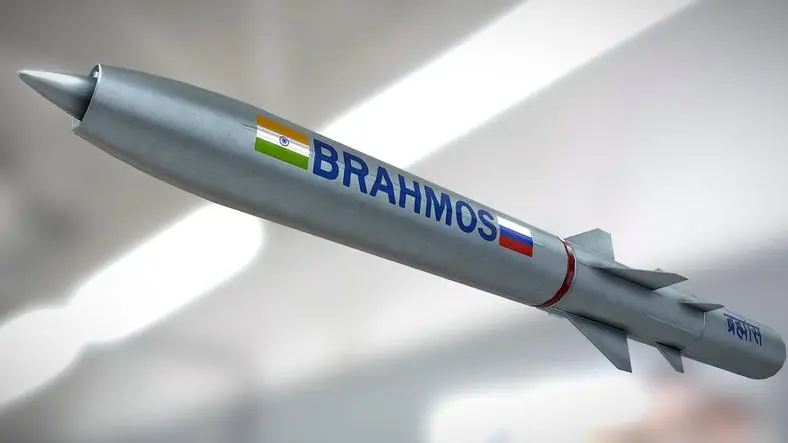
When it comes to modern missile technology, few names command as much global attention as BrahMos—a missile system renowned for its unmatched speed, precision, and versatility. Recognized as the world’s fastest operational anti-ship cruise missile, BrahMos symbolizes India’s rapidly advancing defense capabilities and its strategic partnership with Russia.
What Is BrahMos?
BrahMos is a medium-range, ramjet-powered supersonic cruise missile developed jointly by:
- India’s DRDO (Defence Research and Development Organisation)
- Russia’s NPO Mashinostroyeniya
The missile gets its name from the Brahmaputra River in India and the Moskva River in Russia.
BrahMos Aerospace, the joint venture company, oversees development, manufacturing, testing, and deployment of all BrahMos variants.
Why BrahMos Is the World’s Fastest Anti-Ship Cruise Missile
BrahMos travels at Mach 2.8 to Mach 3, making it:
- 3× faster than traditional subsonic cruise missiles
- Faster than all other anti-ship cruise missiles currently in service
- Extremely difficult to intercept, because air-defense systems get only a few seconds to react
Its speed, combined with powerful terminal maneuverability and pinpoint accuracy, makes it one of the most feared weapons in modern naval warfare.
Where Can BrahMos Be Launched From?
BrahMos is designed as a universal missile, meaning it can be fired from:
- Land-based mobile launchers
- Warships and naval destroyers
- Submarines (vertical launch)
- Aircraft such as the Su-30MKI
This flexibility allows India to deploy BrahMos across land borders, coastlines, and maritime areas.
Current Operational Status
Several versions of BrahMos are already in active service:
- Land-based BrahMos – deployed along India’s borders
- Ship-launched BrahMos – used by Indian Navy destroyers and frigates
- Air-launched BrahMos – integrated on Su-30MKI fighters, operational since 2019
- Submarine-launched BrahMos – tested successfully, awaiting further integration
These deployments significantly enhance India’s strike capability across multiple domains.
Origins of BrahMos: How the Missile Was Conceived
India envisioned a modern missile similar to the Russian P-700 Granit, known for its high speed and ship-killing power. After Russia agreed to collaborate, both nations combined their strengths:
- Russia supplied propulsion expertise
- India developed advanced guidance and navigation systems
This partnership resulted in a superior missile with unmatched performance.
Over time, BrahMos orders from India alone are expected to cross USD 13 billion, making it one of the world’s most valuable missile projects.
Key Capabilities of BrahMos
1. Supersonic Speed (Mach 3)
Supersonic speed gives BrahMos three major advantages:
- Enemy radars have far less reaction time
- Interceptors struggle to track it
- Its kinetic energy on impact becomes devastating
Even without a large warhead, brahmos can destroy heavily armored warships due to the sheer force of impact.
2. High Accuracy
BrahMos is equipped with:
- Advanced INS (Inertial Navigation System)
- GPS/GLONASS satellite guidance
- Active radar homing in the terminal phase
This allows it to strike targets with 1–5 meter accuracy, even in challenging combat environments.
3. Sea-skimming Capability
BrahMos can fly extremely low:
- As low as 3–5 meters above sea level in its terminal phase
This low-altitude “sea-skimming” flight path helps it avoid enemy radars until the last moment.
4. Stealth and Maneuverability
The missile features:
- Low Radar Cross Section (RCS)
- High maneuverability
- A sophisticated evasion sequence in the final seconds
All of this makes it a nightmare for enemy air-defense systems.
How India Extended BrahMos’s Range
Originally, BrahMos was restricted to 290 km because Russia was not a member of the MTCR (Missile Technology Control Regime).
But after India joined MTCR in 2016, the doors opened for development of longer-range versions.
Key advancements:
- 2017: Extended version tested successfully (400 km)
- 2019: Latest version upgraded to 650 km
- Future goal: Extend range to 1,500 km
These upgrades significantly boost India’s deep-strike capability in both land and maritime theaters.
Google Ad 1
Future Variants of BrahMos: What’s Coming Next
1. BrahMos-II (Hypersonic Missile – Mach 7–8)
BrahMos-II is the most anticipated next-gen upgrade.
Expected features:
- Hypersonic speed: Mach 7–8
- Uses a scramjet engine
- Capable of penetrating next-gen air-defenses
- Strike time drastically reduced
- Much higher survivability in hostile environments
BrahMos-II could redefine India’s long-range precision strike capabilities.
2. BrahMos-NG (Next Generation Lightweight Variant)
This is a compact, lighter version of BrahMos designed for more platforms.
BrahMos-NG features:
- Weight: 1.5 tons (compared to 3-ton original)
- Length: 5 meters
- Speed: Mach 3.5
- High maneuverability
- Can be carried by fighter jets such as:
- HAL Tejas
- Rafale
- MiG-29
- Su-30MKI (3 missiles instead of 1 BrahMos)
This will dramatically enhance India’s air-to-surface strike capacity.
3. UCAV-Integrated BrahMos
BrahMos Aerospace is exploring integration into:
- Unmanned Combat Aerial Vehicles (UCAVs)
- Stealth drones
This will enable autonomous deep-strike missions without risking pilot lives.
4. Vertical Launch Submarine Variant
A submarine-launched BrahMos has already been successfully tested. Naval plans include:
- Deployment on future Indian submarines
- Capability to strike enemy ships from underwater
- Reduced detectability
This makes BrahMos a crucial asset for underwater warfare dominance.
APJ Abdul Kalam’s Vision for BrahMos
Former President Dr. A. P. J. Abdul Kalam, the “Missile Man of India,” played a key role in guiding BrahMos’s development.
He encouraged the team to:
- Build a hypersonic variant
- Innovate indigenously
- Push for a missile capable of high-speed return flight
His vision continues to inspire BrahMos Aerospace’s long-term roadmap.
Strategic Importance of BrahMos for India
1. Deterrence Power
BrahMos strengthens India’s position against hostile naval activities in the Indian Ocean Region (IOR).
2. Precision Land Attack
It enables India to strike:
- Enemy bases
- Command centers
- Missile launch sites
- Fortified bunkers
with exceptional accuracy.
3. Boost to Make in India
Over the years, India has increased domestic manufacturing of BrahMos components, reducing dependence on foreign suppliers.
4. Export Potential
Several countries—such as the Philippines—have already placed orders. Many others are in negotiation. This boosts India’s reputation as a global defense exporter.
Conclusion
BrahMos stands as a symbol of India’s technological strength, military preparedness, and international collaboration. As the world’s fastest anti-ship cruise missile currently in operation, it provides unmatched speed, precision, and strategic capability.
With upcoming innovations like:
- BrahMos-II (Mach 7–8 hypersonic)
- BrahMos-NG (lightweight variant)
- UCAV-integrated versions
- Extended range up to 1,500 km
the future of BrahMos is brighter and more powerful than ever.
This missile system not only enhances India’s defense capabilities but also represents a major milestone in global missile technology.
Thanks for reading the article! For more detailed defense and technology explainers, explore more posts on PeoplesBLOG.